Retail insolvency analysis · 26 November 2026
Dollar Tree vs Poundland: why one discounter is thriving and the other has collapsed
Both should be winning a cost-of-living squeeze. On 24 November Dollar Tree beat its own sales forecast and raised its profit outlook. The next day Poundland called in administrators. The gap between them is less about British shoppers and more about pricing discipline, competition, property, costs and, above all, ownership.
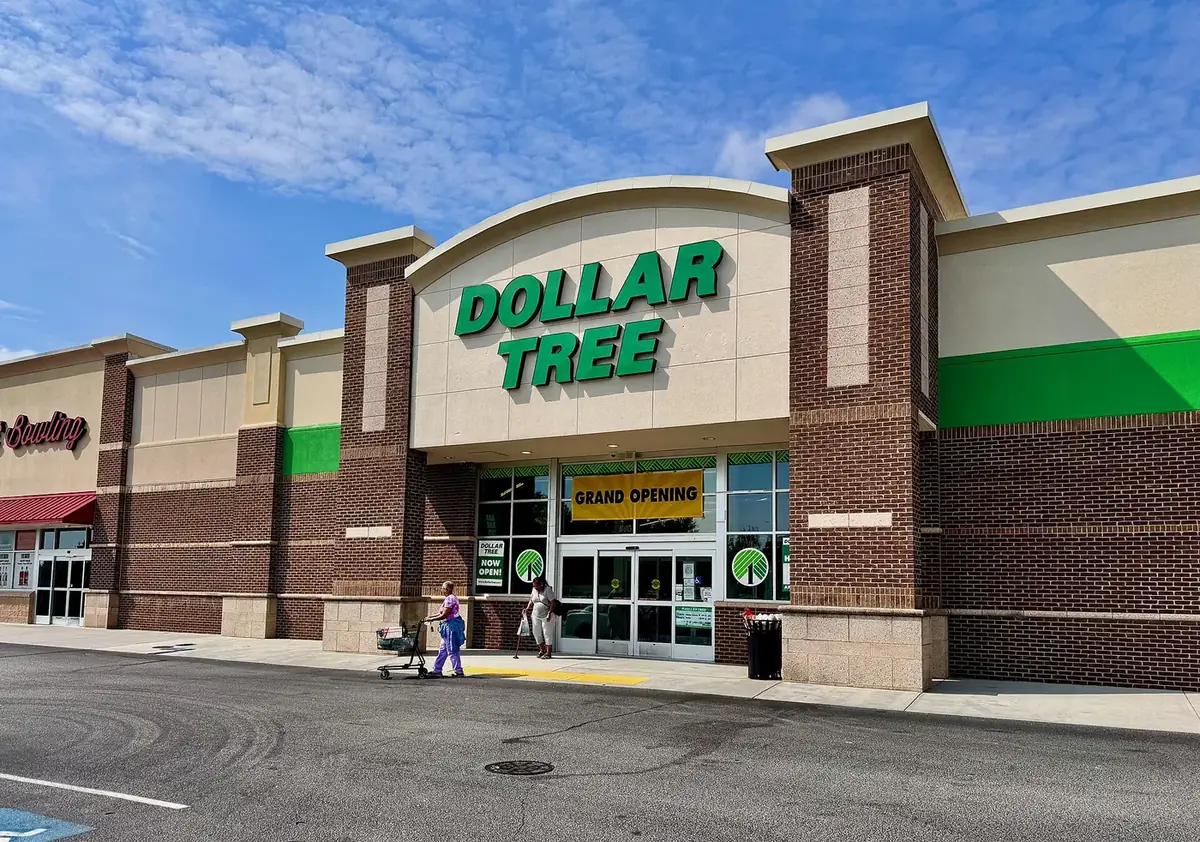
Dollar Tree
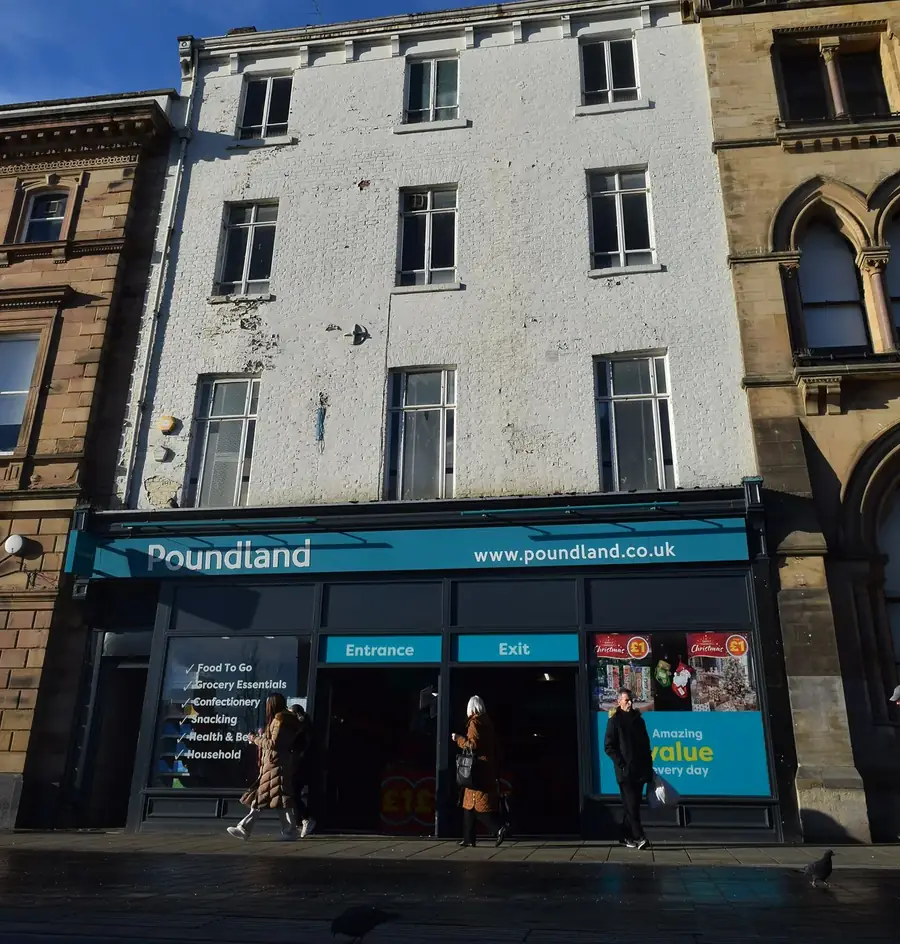
Poundland
Left: Dollar Tree, Greenville, South Carolina. Photo: Harrison Keely, CC BY 4.0. Right: Poundland, High Row, Darlington. Photo: Mtaylor848, CC BY-SA 4.0. Both via Wikimedia Commons.
The two businesses this week
Dollar Tree · Q3 to 31 October 2026
+4.6%
comparable store sales[1]
- Stores
- 9,511
- Customer traffic
- +3.8%
- New stores in quarter
- 84
- FY26 sales outlook
- $20.6–20.7bn
Poundland · 25 November 2026
Administration
AlixPartners appointed by the directors[2]
- Stores (UK & Ireland)
- c.600
- Jobs at risk
- 10,000+
- Suppliers exposed
- c.2,000
- Price paid by owner, 2025
- £1
Job estimates vary by source: AlixPartners said more than 10,000, Sky News reported 10,500 and ITV 11,000.[2][3]
1. Two very different trajectories
Dollar Tree's third quarter was its strongest in some time. Comparable sales rose 4.6%, driven mainly by a 3.8% rise in customer numbers rather than higher prices, and the company lifted its full-year adjusted earnings guidance to $8.05–$8.25 a share.[1] It opened 84 stores in the quarter and now trades from 9,511.
Poundland, founded with a single shop in Burton upon Trent in 1990 and once Britain's biggest single-price retailer, went the other way. Its board filed a notice of intention to appoint administrators in October, won a two-week extension, and called in AlixPartners on 25 November after its owner declined to fund it further. The administrators said a sale process "did not identify a viable solvent solution for the business as a whole".[2]
2. Dollar Tree managed the end of fixed-price retail better
Both chains were built on one price, and inflation broke that model for both. The difference is in what replaced it.
Dollar Tree moved its core price from $1 to $1.25 in 2021, then layered higher price points on top. By the end of October about 7,400 stores carried its multi-price format, and multi-price items made up roughly 18% of sales, up around three percentage points in a year.[1][14]
Dollar Tree's price ladder
$1.25
Everyday essentials and impulse buys
$3
Better products, larger packs
$5+
Household, seasonal, party and leisure
Higher price points add categories a $1.25 store could never stock. The entry price stays low, so the store still reads as cheap.
Poundland also abandoned the single £1 price, from 2017 onwards, but the move cost it the identity that made it simple to shop. As one assessment quoted by the BBC put it, "Removing this identity alienated its core shopper base."[9] Its push into clothing, chilled and frozen food and pricier general merchandise put it head to head with retailers who already did those things well.
The distinction is subtle but important. Dollar Tree's extra price points extend what a customer can buy on one trip. Poundland's diluted the reason to make the trip at all.
3. The UK discount market is unusually crowded
Poundland is squeezed from nearly every direction, and in most British towns its rivals sit within a short walk of each other.
| Category | Who Poundland competes with |
|---|---|
| Cheap groceries | Aldi, Lidl, Iceland |
| Household products | B&M, Home Bargains |
| Toiletries | Savers, supermarkets |
| Affordable clothing | Primark, supermarket clothing ranges |
| Stationery and crafts | The Works, Action |
| Novelty and gadgets | Temu, Shein |
| Everyday essentials | Tesco, Asda and other supermarkets |
Dollar Tree faces Walmart, Dollar General, Aldi and Amazon too. But America's scale and lower population density give a small neighbourhood store a convenience advantage that a British high-street shop, with three rivals on the same parade, does not have.
British shoppers did not stop wanting bargains; they found better ones elsewhere. Card-spend data from Consumer Edge shows Poundland lost more than 15% of its individual shoppers between 2022 and 2026. B&M and Home Bargains each gained about a point of penetration, recovering less than half of those lost, which suggests many younger customers moved to online discounters instead.[10]
4. Different property models create different pressures
Typical Dollar Tree
Strip shopping centre in the suburbs. Free parking at the door, easy deliveries and a standard 8,000–10,000 sq ft box that is cheap to fit out and repeat.[12]
Typical Poundland
Town-centre unit or shopping precinct, reliant on passing footfall. Older buildings in varied sizes, business rates and some historic leases priced for a busier high street.
For a retailer earning pennies on each basket, the economics of each individual shop matter enormously. Not every Poundland site is weak, and not every US lease is cheap, but a legacy high-street estate exposes a business to falling town-centre footfall in a way that a suburban, car-borne format largely avoids.
5. The UK cost base turned hostile
Poundland's former owner, Pepco, warned in late 2024 that the government's changes taking effect in April 2025 "will also add further pressure to Poundland's cost base".[7] Those pressures arrived together:
- National Living Wage increases
- Higher employer National Insurance
- Business rates and occupancy costs
- Energy, freight and distribution
- Inflation in imported stock
- Shop theft and shrinkage
A retailer whose brand promise is "cheap" cannot pass these costs straight on without undermining that promise. Dollar Tree faces rising wages, freight and tariffs too, but it has far greater buying scale, a working multi-price model to absorb inflation, and the balance sheet to wait. Recent US tariff refunds have also flattered its earnings, and it is reinvesting part of them in prices.[1]
6. Poundland made significant strategic mistakes
Under Pepco, Poundland switched to group-level buying, for clothing from September 2023 and general merchandise from March 2024, to gain scale across Europe. The UK buying team that had protected the £1 price point was largely dismantled.[8]
It did not work. Pepco later admitted the new clothing range had too few sizes and that "our UK customers had a different expectation of the Poundland brand proposition compared with Pepco customers".[8] Poundland itself told the BBC that Pepco-sourced clothing and general merchandise "didn't fully align with UK & Ireland customers' expectations".[9]

Dollar Tree moved in the opposite direction. In July 2025 it completed the sale of its long-underperforming Family Dollar chain for about $1bn, leaving management free to concentrate on its stronger core business.[11]
| Dollar Tree | Poundland under Pepco |
|---|---|
| Narrowed to its core business | Spread into new categories |
| Expanding a format that works | Managing a struggling legacy estate |
| Investing in stores | Restructuring and closing stores |
| Clear customer proposition | Searching for its identity |
7. Ownership may have been the decisive factor
This is where the comparison becomes uncomfortable. Poundland's turnaround was working.
After Gordon Brothers bought the chain from Pepco for a nominal £1 in June 2025,[6] the business went through a court-approved restructuring plan. It closed 149 stores, cut about 2,200 jobs, returned to simple £1, £2 and £3 grocery pricing, rebuilt its own clothing design and buying, and stripped out distribution and central costs.[5]
Poundland EBITDA, years to September
Unaudited management figures, £m
+£86.2m
swing in one year
Source: memo from managing director Barry Williams to staff, reported by ITV News and Retail Gazette, November 2026.[4]
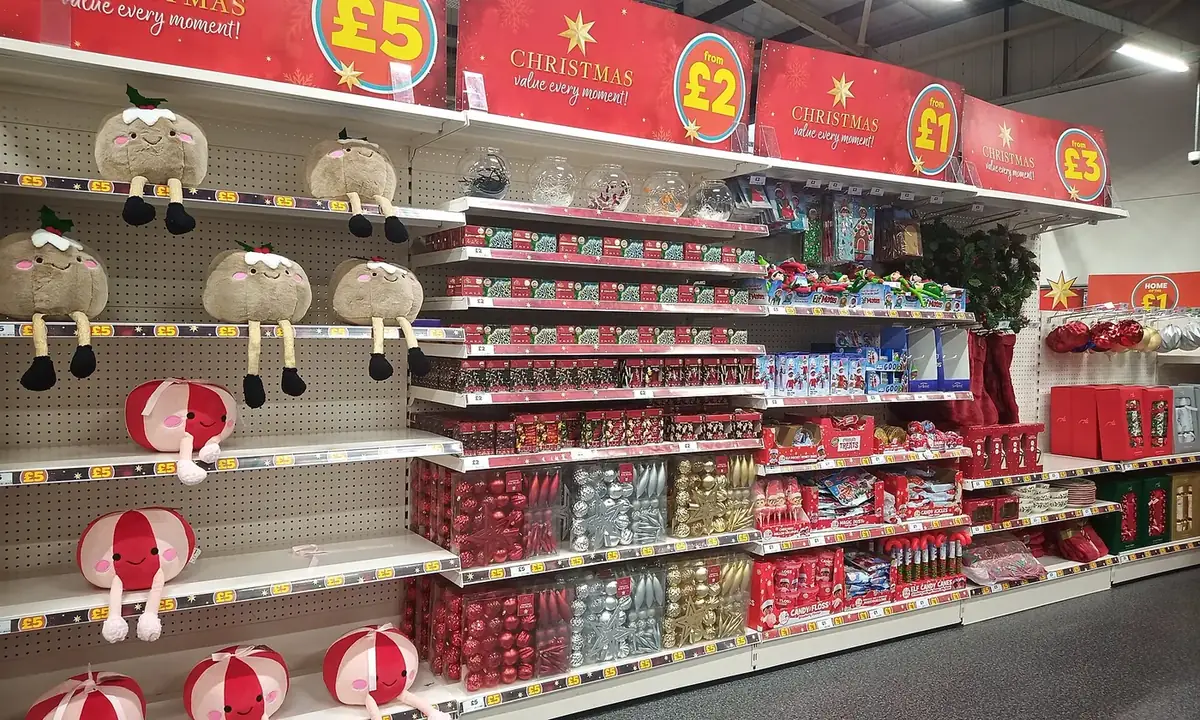
Then the sale process stalled. Bids from management backed by Martin Property Group, and later from Germany's Zachert Private Equity, offered only a small upfront payment for the roughly £30m of shareholder loans Gordon Brothers and Pepco had put in. Gordon Brothers said it could recover more from a break-up.[2] Reports described the business being blocked from buying new stock and struggling to pay suppliers, with shelves emptying ahead of Christmas.[4][2] MPs on the business select committee said the owner had taken close to £20m in interest and fees since the acquisition.[13]
Gordon Brothers disputes that it withheld funds. It says it stepped in "when no one else was willing to finance the business" and that Poundland remained "vulnerable to inflationary pressures or any downturn in sales and margin".[2]
Positive EBITDA is not the same as enough cash to survive. But an £86m swing raises a fair question: was administration the only route left?
From a turnaround perspective, this is the pattern we see most often in distressed companies: operational recovery runs ahead of the balance sheet. Working capital, supplier credit and the lender's or owner's appetite decide whether a business gets the time to prove the recovery, and those levers sit with the capital structure, not the shop floor.
8. Dollar Tree sells more than cheap essentials
There is also a difference in why people go. Dollar Tree leans heavily into discretionary categories: party supplies, seasonal decorations, crafts, gifts and homewares, alongside everyday consumables. These drive impulse buying and repeat visits, and they carry better margins than branded groceries, where shoppers can check prices instantly. Its annual report credits higher-margin discretionary merchandise with improving profitability.[12]

A shopper buying toothpaste, washing-up liquid and chocolate at Poundland is comparing every price with Tesco, Aldi and B&M. Dollar Tree has done more to make bargain hunting feel like a treat rather than a chore.
How much did each factor matter?
Our qualitative judgement of what explains the divergence. These are not measured contributions to either company's results, and the circumstances of Poundland's insolvency remain contested.
Could a Dollar Tree work in Britain?
Probably, if it were built for British conditions: a firm £1.25–£1.50 entry price, a tight selection of higher-priced lines, a strong seasonal and party range, accessible retail-park sites, and an owner willing to invest for the long term. It would look something like the original Poundland crossed with Home Bargains and The Range, with a simpler price structure.
Poundland's collapse does not prove the dollar-store model fails in Britain. Dollar Tree shows how the model can grow beyond a single price. Poundland shows how strategic errors, rising costs, fierce competition and an unstable capital structure can bring down an established retailer, and how a recovery can arrive too late to be allowed to finish.
Running a business where trading is recovering but cash is not?
K2 has helped UK directors restructure, refinance and buy back businesses under pressure since 2001. The earlier you talk to us, the more options stay open.
Looking at Poundland stores or stock? See buying a business from administration and the latest administration notices.
Sources
- [1]Dollar Tree, Inc. Reports Third Quarter Results. Dollar Tree, Inc., 24 November 2026.
- [2]Poundland collapses, putting more than 10,000 jobs at risk. The Guardian, 25 November 2026.
- [3]Poundland collapse into administration leaves 10,500 jobs at risk. Sky News, 25 November 2026.
- [4]Poundland blocked from buying new stock despite £86m turnaround (citing ITV News). Retail Gazette, November 2026.
- [5]Poundland shuts 149 stores, cuts 2,200 jobs and focuses on £1 items. The Guardian, 23 January 2026.
- [6]Poundland sold for £1 with dozens of store closures expected. The Guardian, 12 June 2025.
- [7]Poundland could be put up for sale as taxes rise, owner says. BBC News, December 2024.
- [8]Poundland: what's gone wrong and what can it do to fix it?. The Grocer, 2024.
- [9]'I used to spend £50 there': What's gone wrong at Poundland?. BBC News, 2025.
- [10]UK Discount Retail Checkup: B&M vs. Home Bargains as Poundland Retreats. Consumer Edge, 2026.
- [11]Dollar Tree Completes Sale of Family Dollar Business. Dollar Tree, Inc., 7 July 2025.
- [12]Annual Report 2024. Dollar Tree, Inc. (SEC filing), 2025.
- [13]Poundland owner extracted millions when chain was on 'knife-edge', MPs say. The Guardian, 11 November 2026.
- [14]Dollar Tree Q3 earnings boosted by high shopper traffic. Progressive Grocer, November 2026.
Store photographs from Wikimedia Commons under the Creative Commons licences credited beneath each image; the Darlington photo is cropped. Figures are as reported at publication and may change as the administration proceeds.