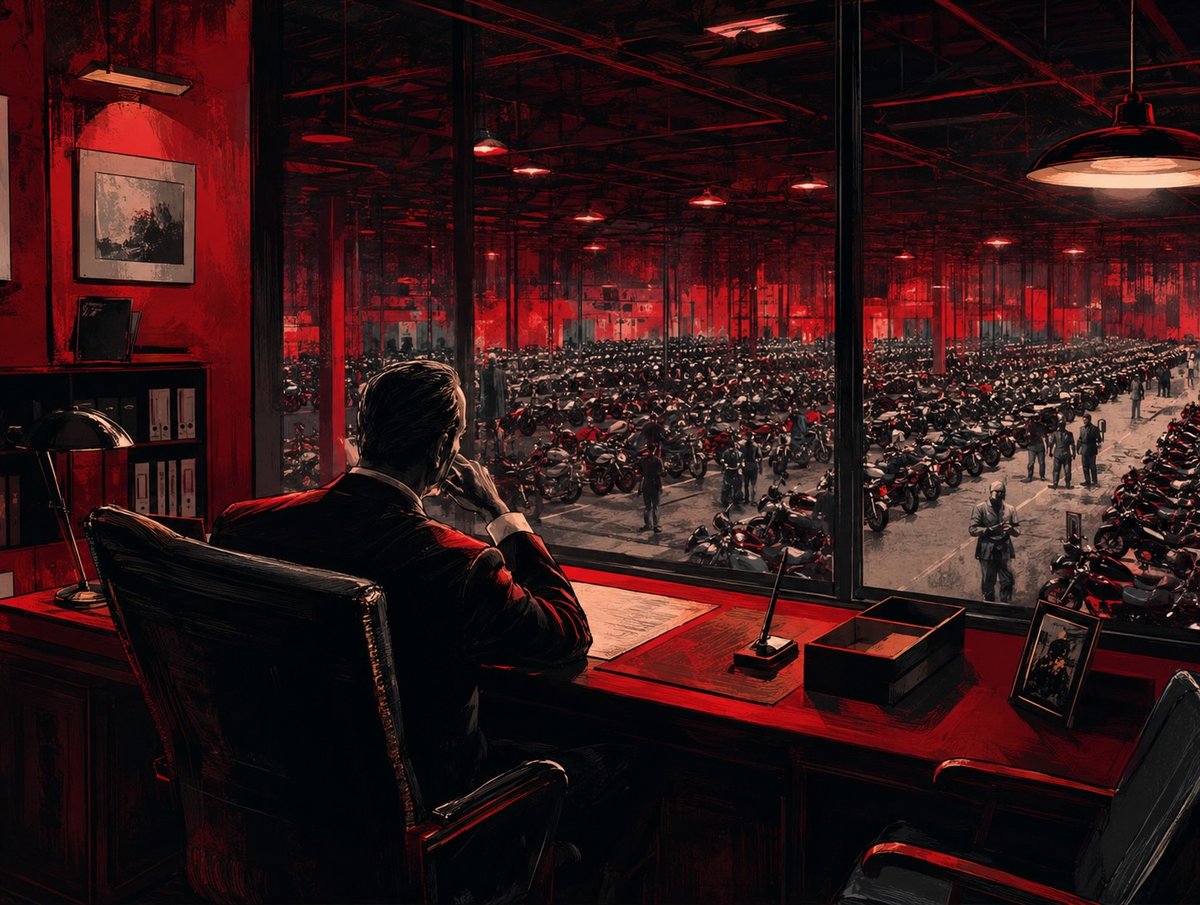
SuperBike Factory’s Rapid Ascent and Sudden Stop
SuperBike Factory grew from a single Macclesfield base into what it marketed as Europe’s largest used motorcycle retailer, selling over 15,000 bikes a year and employing more than 270 staff. Its model combined high‑volume bike purchasing via online channels with central preparation and nationwide sales through large destination showrooms and a strong web presence. By late 2024 it operated six sites across England—Macclesfield, Donington Park, Bradford, Bristol, Milton Keynes and Crawley—offering everything from learner bikes to premium adventure machines, plus MOT, workshop and rider‑training services.
The growth trajectory looked impressive: revenues edged above £82m in 2024 and bike volumes continued to rise, cementing the brand as a dominant force in used motorcycle retail. However, behind the headline turnover, profitability deteriorated sharply and balance sheet pressure built, leaving the group increasingly exposed to any shock in finance availability or consumer demand. That vulnerability became critical in 2026, as regulatory, financial and market headwinds converged and turned a high‑flying expansion story into an insolvency case managed by specialist firm KR8 Advisory.
From Profit to Collapse: How the Numbers Stopped Adding Up
Only a few years prior to administration, SuperBike Factory was reporting healthy profits, including a pre‑tax figure of around £8.5m on turnover of roughly £83m. By the time full 2024 accounts were filed at Companies House, the picture had flipped: revenue was modestly higher at £82.248m, but the business recorded a post‑tax loss of £18.28m. That swing of more than £26m suggests a brutal squeeze on margins, higher financing and operating costs, and possibly stock and goodwill write‑downs as the used market softened and expansion costs bit.
The board itself acknowledged serious risks in those accounts. Management warned that the ongoing fallout from discretionary commission arrangements in motor finance could restrict customers’ access to loans or alter the economics of finance deals, undermining the volume‑driven model. They also flagged rising living costs and weak consumer confidence as threats to future trading, recognising that motorcycles are a discretionary purchase that can quickly fall out of favour when household budgets tighten. The financial statements showed that by the end of 2024, cash and net assets were under pressure, leaving little room for error if trading deteriorated further.
From Notice of Intention to Full Administration and Closure
In mid‑2026 the first public sign of crisis was SuperBike Factory filing a Notice of Intention (NOI) to appoint administrators, a legal move that temporarily protected it from creditor action while options such as a sale, refinancing or restructuring were explored. At that stage, reports and commentary stressed that an NOI is not administration itself but often a precursor, giving directors 10 working days (sometimes more with extensions) to secure a rescue. Industry coverage described the group as “running out of road”, with hundreds of jobs at risk and potential buyers or investors being sounded out behind the scenes.
Those efforts ultimately failed. On 20 July 2026, KR8 Advisory announced that Michael Lennon, James Saunders and Robert Halliday had been appointed as joint administrators of both Superbike Factory Group Limited and Superbike Factory Limited under the Insolvency Act 1986. The statement confirmed that the companies had ceased to trade with immediate effect, meaning all showroom operations and central functions stopped the day of appointment. From that point, the affairs, business and property of the companies have been managed by the joint administrators as agents of the companies, without personal liability, with all customer and creditor enquiries directed to a dedicated KR8 email. This marks a clear transition from “at risk of administration” to full insolvency and shutdown.
The Motor Finance Redress Shock and Market Headwinds
The wider regulatory environment around motor finance has been a critical backdrop to SuperBike Factory’s fall. For years, many dealers and brokers—including bike retailers—used discretionary commission arrangements, allowing them to flex customers’ interest rates to earn higher commissions. Following the Johnson case and a wave of complaints, the Financial Conduct Authority concluded that many consumers had been overcharged and in 2026 confirmed a redress scheme covering regulated motor finance agreements between 2007 and November 2024 where commission was payable to brokers. The FCA now expects firms to pay around £7.5bn in redress plus £1.6bn in non‑redress costs, a roughly £9.1bn hit to the sector.
Although the primary liability sits with lenders, the knock‑on effects for volume motor retailers are severe. Lenders are reassessing risk, tightening affordability checks and revisiting commission structures, all of which can reduce approvals and margins on financed deals—exactly the income streams that underpin a high‑volume used bike business. SuperBike Factory’s accounts explicitly cited “growing uncertainty” around the availability of motor finance as a risk, and that risk has now crystallised into real constraints on customers’ ability to borrow. Combined with higher interest rates, cost‑of‑living pressures and a cooling used market after the post‑pandemic boom, the environment turned far harsher than the one in which the company’s rapid expansion was planned.
What Administration and Immediate Closure Mean for Riders and the Industry
With SuperBike Factory now in administration and having ceased trading, its showrooms are closed and no new retail sales are being made through the group. Customers with outstanding issues—such as undelivered bikes, part‑exchange vehicles already handed over, deposits, or warranty claims—must now deal with the joint administrators, who will prioritise according to insolvency law rather than normal customer service principles. Finance agreements already in place are typically contracts with lenders and will usually continue, but ancillary promises such as free servicing, extended warranties or accessories bundles may become unsecured claims against the insolvent estate, with uncertain recovery prospects.
For the wider UK motorcycle market, the collapse of Europe’s largest used bike dealer is a significant shock following the earlier failures of Completely Motorbikes, CCM and Mutt. Other independent dealers have been quick to reassure customers that they are unaffected and continue to trade normally, but SuperBike Factory’s demise is likely to influence used values, auction dynamics and buyer confidence in the short term as thousands of bikes and associated assets are processed through the insolvency. Longer term, the case underscores how exposed high‑growth, finance‑driven retail models are to changes in regulation, interest rates and consumer sentiment: a combination that turned SuperBike Factory from a sector‑leading success story into a cautionary tale in just a few years.