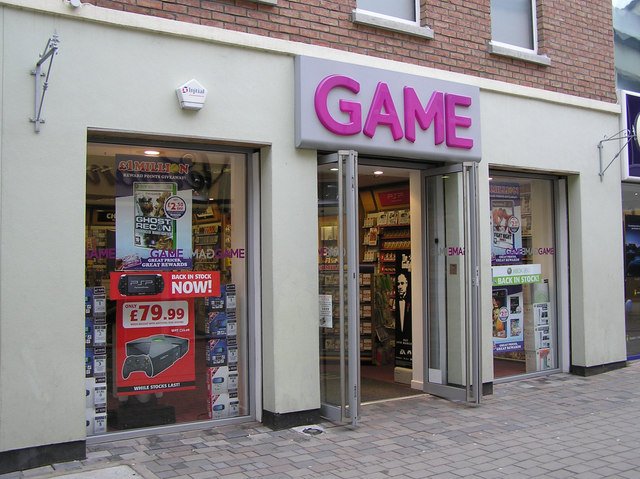
GAME’s Rise, Second Chance, and Ultimate Collapse on the High Street
For more than a decade, GAME was synonymous with buying video games on the British high street, at its peak operating around 300 stores in the UK and running dedicated e‑commerce sites for both the GAME and Gamestation brands. After its first administration in 2012, the chain was relaunched as GAME Digital and tried to rebuild its position through events, pre‑owned trade‑ins and a stronger online presence. Yet the core model still revolved around selling boxed games and hardware in physical stores, just as consumer behaviour was starting a decisive shift towards digital.
Frasers Group began investing in GAME in the mid‑2010s and fully acquired the company in 2019, seeing potential in its brand, concessions and esports‑style Belong arenas. That rescue bought GAME time but did not fix the structural pressures eroding its margins: falling physical software sales, heavy rent and rates, and reliance on console launch cycles. As standalone stores steadily closed, the brand increasingly survived only as a web operation and as concessions tucked into Sports Direct and House of Fraser, foreshadowing that the traditional GAME store experience was living on borrowed time.
By early 2026, the situation was no longer tenable. A notice of intention to appoint administrators was filed in January, and by 24 February 2026, GAME Retail Limited—the entity housing the remaining standalone stores and liabilities—formally entered administration with KR8 Advisory’s James Saunders and Lauren Wentworth appointed as joint administrators. The remaining high street shops shut their doors soon after, leaving only the intellectual property and concessions structure that Frasers had already carved out and ring‑fenced away from the collapse.
From Profit Warnings to £15.8m in Debt: GAME’s Financial Unravelling
The seeds of GAME’s final collapse can be traced back to 2016, when management reported a dramatic 71% fall in profits, a £6.8m slide compared with the year before. By 2017 the company was already loss‑making, posting a pre‑tax loss of £7.1m as margins tightened and footfall weakened across the high street. Those losses ballooned in the following years, with estimates suggesting a cumulative loss of around £43m by 2019, even as Frasers Group stepped in as majority shareholder and later owner.
According to the KR8 Advisory report, the picture had deteriorated sharply by late 2025. Internal management accounts in September 2025 indicated that GAME did not have enough cash to meet its obligations through the crucial final quarter, historically one of its busiest trading periods. In October 2025 the landlord of its head office served a statutory demand for unpaid rent, forcing an urgent restructuring that saw Frasers acquire the company’s intellectual property for cash in order to settle that liability and support the ongoing concessions‑based business.
When GAME Retail Limited finally entered administration, it owed an estimated £15.8m in total. Around £3.5m of that was due to its secured creditor—linked to Frasers Group’s financing—with roughly £12m owed to unsecured creditors ranging from landlords to suppliers and service providers. Administrators anticipate there may be enough realised value to make some payment to the secured creditor and preferential creditors, but general unsecured creditors are expected to see little or nothing beyond a modest prescribed‑part distribution reserved under UK insolvency rules. The numbers underline that, by the end, this was not a temporary liquidity squeeze but a fundamentally insolvent business whose cash‑generation capacity had evaporated.
Digital Downloads, Console Cycles and Pricing Pressure: A Broken Business Model
GAME’s downfall cannot be understood without looking at how players now buy and consume games. Over the past decade, console manufacturers and publishers have steadily pushed customers towards digital downloads, subscription services and live‑service models. By the mid‑2020s, digital accounted for a large and growing share of UK console game sales, eroding the very boxed software business that had historically powered GAME’s profits. At the same time, UK retail data showed physical software revenue falling sharply—boxed game sales dropped by around 35% in 2024 alone—leaving chains like GAME fighting over a shrinking slice of the market.
The KR8 report also highlights the importance of console cycles. Administrators note that there have been “no major console releases since 2020”, with manufacturers citing chip shortages as a cause of further delays, reducing the big hardware‑driven spikes that stores rely on to boost trade. While this language arguably downplays the impact of Nintendo’s Switch successor, analysts and commentators broadly agree that no new machine has transformed the high street in the way the PlayStation 4 or Xbox 360 generations once did. In other words, even when hardware has launched, it has tended to be more supply‑constrained, more expensive, and often easier or cheaper to buy direct from platform holders or online pure‑plays than from GAME.
At a day‑to‑day level, GAME was also trapped in a brutal price war. Supermarkets, online giants and code resellers often undercut its prices on big releases and consoles, while platform‑run digital stores offered heavy discounts and subscription bundles that were impossible for a physical retailer to match. Commentators have long noted that GAME rarely offered the best deal on major launches, encouraging customers to browse in‑store before buying elsewhere—a phenomenon that quietly hollowed out its sales. Over time, even attempts to diversify into esports arenas, accessories and collectibles could not offset the loss of high‑margin new releases and pre‑owned trade‑ins that once sustained the business.
Brexit, Cost‑of‑Living and the Vanishing Spending Power of UK Gamers
While Brexit might appear tangential to a video game retailer’s fate, the macroeconomic drag it has placed on the UK economy fed directly into GAME’s decline. Firm‑level analysis referenced by the Bank of England and later summarised in independent studies suggests Brexit reduced UK GDP by around 6–8% by the mid‑2020s, primarily through weaker investment, lower productivity and reduced trade intensity. That lost output filters through into real wages, consumer confidence and import costs, all of which matter for a retailer dependent on discretionary spending on imported hardware and software.
For GAME, this meant higher costs in the supply chain alongside a customer base squeezed by inflation and stagnant pay. When households are choosing between rising energy bills and a £70 new release, the games budget is one of the first luxuries to be cut or delayed, compressing volumes and pushing retailers into ever fiercer price competition. Administrators explicitly pointed to “uncertainty associated with Brexit” as one of several factors that made already‑difficult market conditions worse, exacerbating the shift to digital and intensifying competition from leaner, online‑only rivals.
These structural pressures collided with a wider cost‑of‑living crisis and the hangover from the pandemic, which changed how and where people shop. UK consumers have grown more comfortable pre‑ordering games digitally, subscribing to services like Game Pass or PlayStation Plus, and buying hardware from platform holders’ own web stores. In that environment, the emotional pull of a local GAME—nostalgic as it might be—was no match for economic reality: fewer people walking into town centres, less disposable income in their pockets, and little incentive to pay more for a boxed copy when a download is a button‑press away.
What GAME’s Collapse Means for the Future of Physical Games Retail
GAME’s administration is not just the story of one company; it is a warning sign for the future of physical game retail everywhere. The market trajectory is clear: platform holders are moving toward digital‑only strategies, with flagship titles like Grand Theft Auto 6 launching without a disc in the box and Sony signalling plans to phase out physical media entirely in the coming years. If major blockbuster releases bypass discs altogether, the traditional role of a specialist retailer—stacking shelves with launch‑day stock and midnight openings—simply disappears.
That does not mean every bricks‑and‑mortar game shop is doomed, but it does mean the surviving players will look very different from the chains of the past. Independent stores can lean harder into retro collecting, imports, repairs, community events and local tournaments—areas where they can offer personality and expertise that digital storefronts cannot replicate. They can also treat physical games as part of a broader hobbyist ecosystem spanning tabletop, merchandise and second‑hand systems, rather than relying on day‑one triple‑A sales. GAME tried versions of this diversification with esports arenas and concessions, but it was hamstrung by its cost base, legacy debts and scale.
Ultimately, GAME’s fall shows what happens when a beloved retail brand is tied too tightly to a format that the industry itself is leaving behind. The company went into administration with £15.8m of debt and little realistic prospect of trading its way back to health, even if the next console generation were to arrive sooner rather than later. With no clear timetable for new hardware, continuing chip‑related supply issues, and a consumer base trained to buy digitally, it is hard to imagine a world in which a nationwide chain of disc‑driven stores could thrive again. For many UK players, GAME’s disappearance feels like the loss of a social hub as much as a shop—but it also marks the end of an era in which the high street sat at the heart of gaming culture.